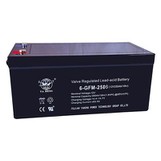
Hey there! As a stand - by battery supplier, I've seen firsthand how important it is to test the performance of these batteries. Stand - by batteries are crucial in many applications, from keeping our electric cleaning machines running during power outages to ensuring our audio systems and security lamps stay functional. In this blog, I'll share some tips on how to test the performance of a stand - by battery.
1. Visual Inspection
Before diving into more technical tests, a simple visual inspection can tell you a lot. First, check for any physical damage to the battery. Look for cracks, leaks, or bulges on the battery casing. A cracked battery could indicate internal damage, and a leaking or bulging battery might be a sign of overheating or a chemical imbalance. If you notice any of these issues, it's likely the battery won't perform well and may even be dangerous.


Also, examine the battery terminals. They should be clean and free of corrosion. Corroded terminals can increase resistance, which affects the battery's ability to deliver power. If you see a white or greenish - blue substance on the terminals, you can clean them with a mixture of baking soda and water. Just make sure to disconnect the battery before cleaning to avoid any electrical shock.
2. Measuring the Open - Circuit Voltage
The open - circuit voltage (OCV) is the voltage of the battery when it's not connected to any load. It's a quick way to get an idea of the battery's state of charge. You'll need a voltmeter for this test.
To measure the OCV, simply connect the positive lead of the voltmeter to the positive terminal of the battery and the negative lead to the negative terminal. For a fully charged lead - acid stand - by battery, the OCV should be around 2.1 volts per cell. For a 12 - volt battery (which usually has six cells), the OCV should be close to 12.6 volts.
If the OCV is significantly lower than the expected value, it could mean the battery is discharged or has some internal problems. However, keep in mind that the OCV can be affected by temperature. In colder temperatures, the OCV might be slightly lower even if the battery is fully charged.
3. Conducting a Load Test
A load test is a more comprehensive way to evaluate the battery's performance under real - world conditions. It measures how well the battery can deliver power when a load is applied.
There are two main types of load tests: the capacity test and the high - rate discharge test.
Capacity Test
The capacity test measures the total amount of charge the battery can deliver over a specific period. This test is usually done over several hours and requires a load bank, which is a device that can simulate a load.
To perform a capacity test, connect the load bank to the battery and set it to a specific current draw. For example, if you're testing a 100 - ampere - hour battery, you might set the load bank to draw 10 amperes. Then, let the battery discharge until its voltage drops to a certain cut - off voltage (usually around 1.75 volts per cell for a lead - acid battery).
The time it takes for the battery to reach the cut - off voltage can be used to calculate its actual capacity. If the battery discharges for 10 hours at a 10 - ampere draw, its capacity is 100 ampere - hours. If it discharges for less time, it means the battery's capacity has decreased.
High - Rate Discharge Test
The high - rate discharge test is used to evaluate the battery's ability to deliver a large amount of current for a short period. This is important for applications where the battery needs to provide a sudden burst of power, like starting an engine or powering a security lamp during an emergency.
To perform a high - rate discharge test, you'll need a high - rate load tester. Connect the tester to the battery and apply a high current (usually several times the battery's rated current) for a short period, typically 15 - 30 seconds.
During the test, monitor the battery voltage. If the voltage drops too quickly or doesn't recover after the load is removed, it could indicate that the battery has a problem with its internal resistance or plate structure.
4. Testing for Self - Discharge
Self - discharge is a natural process where a battery loses its charge over time even when it's not connected to a load. It's important to test for self - discharge because a high self - discharge rate can mean the battery won't hold its charge for long.
To test for self - discharge, first, fully charge the battery and measure its OCV. Then, store the battery in a cool, dry place for a specific period, usually a month. After the storage period, measure the OCV again.
Calculate the percentage of self - discharge by dividing the difference in OCV before and after storage by the initial OCV and multiplying by 100. A normal self - discharge rate for a lead - acid stand - by battery is around 3 - 5% per month. If the self - discharge rate is higher, it could be due to factors like internal short - circuits or a high level of impurities in the battery.
5. Using Advanced Testing Equipment
In addition to the basic tests mentioned above, there are also some advanced testing equipment available that can provide more detailed information about the battery's performance.
For example, a battery analyzer can measure parameters like internal resistance, state of health (SOH), and state of charge (SOC) more accurately. It uses sophisticated algorithms to analyze the battery's electrical characteristics and can give you a comprehensive report on the battery's condition.
Some battery analyzers can also perform automated tests, which can save you a lot of time and effort. They can automatically apply different loads, measure the battery's response, and generate test results.
Applications of Stand - by Batteries and Their Testing Requirements
Stand - by batteries are used in a wide range of applications, each with its own specific testing requirements.
Electric Cleaning Machine Battery
Electric Cleaning Machine Battery needs to be able to provide a consistent amount of power for a reasonable period to keep the cleaning machine running. For these batteries, a capacity test is crucial to ensure they can last through a full cleaning cycle. Additionally, a high - rate discharge test might be necessary to check if the battery can handle sudden power surges when the machine starts or stops.
Audio Battery
Audio Battery is used to power audio systems, which require a stable power supply to produce high - quality sound. Testing the battery's voltage stability during a load test is important to make sure there are no fluctuations that could affect the audio quality. A self - discharge test is also essential because audio systems might not be used frequently, and the battery needs to hold its charge for a long time.
Security Lamp Battery
Security Lamp Battery needs to be able to provide a high amount of power quickly in case of an emergency. A high - rate discharge test is a must for these batteries to ensure they can illuminate the lamp instantly. Capacity testing is also important to make sure the lamp can stay lit for a sufficient period.
Conclusion
Testing the performance of a stand - by battery is crucial to ensure its reliability and longevity. By following the steps outlined in this blog, you can identify any potential problems early and take appropriate measures to maintain or replace the battery.
If you're in the market for high - quality stand - by batteries for your electric cleaning machines, audio systems, or security lamps, we're here to help. Our batteries are rigorously tested to meet the highest standards of performance and reliability. Contact us today to discuss your battery needs and start a procurement negotiation. We look forward to working with you!
References
- Battery Testing Handbook, Battery Council International
- Understanding Battery Performance, Energy Storage Association