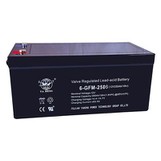
Hey there! As a supplier of UPS batteries, I often get asked about the capacity of a typical UPS battery. It's a crucial question, especially for those who rely on uninterrupted power supply (UPS) systems to keep their devices running during power outages. In this blog post, I'll break down what UPS battery capacity means, factors that affect it, and how to choose the right capacity for your needs.
What is UPS Battery Capacity?
Let's start with the basics. The capacity of a UPS battery refers to the amount of electrical energy it can store and deliver. It's usually measured in ampere - hours (Ah) or watt - hours (Wh). Ampere - hours tell you how many amps the battery can supply over a certain period of time. For example, a 10Ah battery can supply 1 amp of current for 10 hours or 2 amps for 5 hours.
Watt - hours, on the other hand, take into account the voltage of the battery. Since power (in watts) is calculated as the product of voltage (V) and current (A) (P = V x I), watt - hours give a more accurate picture of the actual energy available. To convert from ampere - hours to watt - hours, you simply multiply the ampere - hours by the battery voltage. For instance, a 12V, 10Ah battery has a capacity of 120Wh (12V x 10Ah).
Factors Affecting UPS Battery Capacity
Several factors can influence the capacity of a UPS battery.
Battery Chemistry
Different battery chemistries have different energy densities and performance characteristics. The most common types of batteries used in UPS systems are lead - acid batteries, including valve - regulated lead - acid (VRLA) batteries such as absorbed glass mat (AGM) and gel batteries, and lithium - ion batteries.
Lead - acid batteries are known for their relatively low cost and reliability. However, they have a lower energy density compared to lithium - ion batteries. This means that for the same physical size, a lithium - ion battery can store more energy. For example, a lithium - ion battery might have an energy density of around 150 - 200Wh/kg, while a lead - acid battery typically has an energy density of 30 - 50Wh/kg.
Temperature
Battery capacity is highly sensitive to temperature. In general, as the temperature decreases, the chemical reactions inside the battery slow down, reducing its capacity. Conversely, high temperatures can increase the rate of chemical reactions, but they also accelerate battery aging and can cause damage over time.


Most UPS batteries are designed to operate optimally at around 25°C (77°F). For every 10°C increase above this temperature, the battery's self - discharge rate can double, and its lifespan can be significantly reduced. On the other hand, if the temperature drops below 0°C (32°F), the battery's capacity can decrease by up to 50%.
Depth of Discharge (DoD)
The depth of discharge refers to the percentage of the battery's capacity that has been used. The more deeply a battery is discharged, the more stress it experiences, which can reduce its overall lifespan. For example, if you regularly discharge a battery to 80% of its capacity, it will likely have a shorter lifespan compared to a battery that is only discharged to 20%.
Most UPS systems are designed to prevent deep discharges to protect the battery. They typically have a low - voltage cutoff feature that disconnects the load when the battery voltage drops to a certain level.
How to Choose the Right UPS Battery Capacity
Now that you understand what UPS battery capacity is and what affects it, how do you choose the right capacity for your needs?
Determine Your Load Requirements
The first step is to figure out how much power your devices need. Make a list of all the devices you want to connect to the UPS, including their power ratings in watts. You can usually find this information on the device's label or in its user manual.
Add up the power ratings of all the devices to get your total load. For example, if you have a computer that uses 300W, a monitor that uses 50W, and a router that uses 10W, your total load is 360W.
Decide on the Backup Time
Next, you need to decide how long you want the UPS to keep your devices running during a power outage. This will depend on your specific needs. If you just need enough time to save your work and shut down your computer properly, a few minutes might be sufficient. However, if you're running critical equipment like a server or medical device, you might need several hours of backup power.
Once you know your total load and the desired backup time, you can calculate the required battery capacity. For example, if your total load is 360W and you want a backup time of 1 hour, you need a battery with a capacity of at least 360Wh. Keep in mind that you should also factor in the efficiency of the UPS, which is usually around 80 - 90%. So, in this case, you might need a battery with a capacity of around 400 - 450Wh to account for the efficiency losses.
Our Product Range
As a UPS battery supplier, we offer a wide range of batteries to meet different needs. Our Jump Starter Battery is a great option for those who need a portable and reliable power source for emergency situations. It's designed to provide a quick boost of power to start vehicles or charge small electronic devices.
If you're looking for a high - performance UPS system for critical applications, our On - line UPS is the way to go. It provides continuous power to your devices, even during power fluctuations or outages, ensuring maximum protection for your equipment.
And of course, our UPS Power Battery comes in various capacities and chemistries to suit different load requirements and backup time needs. Whether you need a small battery for a home office or a large battery for a data center, we've got you covered.
Contact Us for Procurement
If you're in the market for a UPS battery, we'd love to help you find the right solution for your needs. Our team of experts can provide you with detailed information about our products, help you calculate the required battery capacity, and offer competitive pricing.
Don't hesitate to reach out to us to start the procurement process. We're committed to providing high - quality products and excellent customer service.
References
- Battery University: A comprehensive resource for battery knowledge.
- IEEE Standards for Uninterruptible Power Systems (UPS).
- Manufacturer's datasheets for UPS batteries.